 Scoped SEO
 Add to Chrome
Schema
Structured data detected as JSON-LD, Microdata or RDFa, checked in three labelled layers with a readable property inspector.

What it detects
JSON-LD (several scripts, arrays, @graph, nested objects, several @type values, @id references and scripts added by JavaScript), Microdata and RDFa. One invalid script never breaks the others. The header counts entities, blocks and distinct types separately, and an @id reference is never counted as a second entity.
Three layers of validation
- Syntax. Is the JSON valid?
- Schema.org structure. Are the types and properties real, and used where they belong?
- Google rich result requirements. Does the entity have what Google asks for a given feature?
Each card shows Valid syntax, Warning, Error or Not checked. The header reads No syntax issues detected, Validation warnings found, Invalid JSON-LD detected, Partially evaluated or Not evaluated.
Property inspector
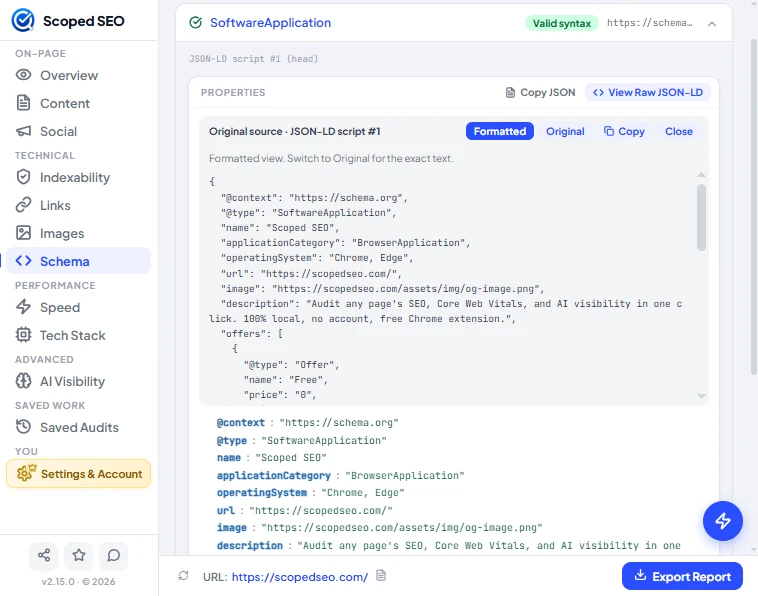
Open a card to see its properties. Nested objects appear as collapsed rows with a short summary. Missing required properties show as ghost rows inside the object that lacks them, and missing recommended ones sit in one collapsed row. A flag appears on a property only when there is evidence for it.
- Copy JSON copies the block. You can also copy a single property, the original source or the page URL.
- View Raw JSON-LD shows the script exactly as written on the page, with a separate formatted view. Invalid JSON is shown as written. Microdata and RDFa cards offer View Source HTML. Nothing is executed.
- Test in Google and Schema Validator are plain links that open on click. Scoped SEO sends nothing to them until you do.
Google rich results
Inside an expanded card, each Google feature that applies shows its status, the required and recommended properties that are missing, a link to Google's documentation and the date the rules were last checked. There is no score. Types with no Google feature read as informational.
Duplicates and conflicts
The same @id with different values is marked Conflict. Identical entities are Duplicate. Similar entities of one type are Review Suggested. Ordinary @id references and repeated types are never flagged.
Export
Export Schema downloads schema.json with the source URL, detection format, types, entity id, properties, validation status, issues, source block, scan time and methodology version. Reports in PDF, DOCX and CSV use the same facts.