 Scoped SEO
 Add to Chrome
Indexability
Can search engines crawl and index this page? Status, canonical, robots directives, robots.txt, sitemaps and hreflang in one place.
A banner at the top gives the verdict, and three sub-tabs hold the evidence: Indexing Signals, Crawl Files and Hreflang.
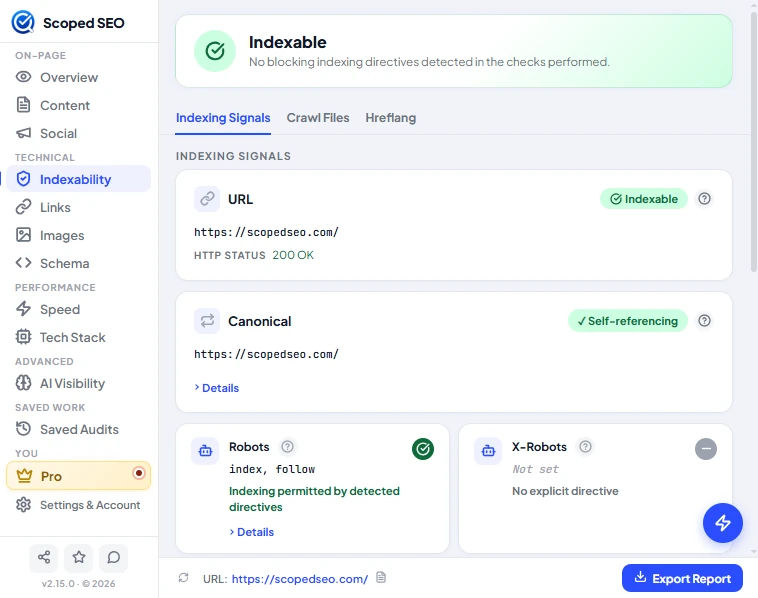
The banner
One of: Indexable, Blocked from indexing, Crawl access potentially restricted, Indexability uncertain or Returns an error status. The wording is deliberately careful. "Indexable" means no blocking directive was found in the checks performed. It never says Google has indexed the page.
Indexing Signals
- URL with its HTTP status from the browser's own navigation entry, and the number of redirects when there were any.
- Canonical with a status: Self-referencing, Points elsewhere, Missing, Multiple or Conflict, Review suggested, or Not evaluated. A closed Details panel explains why. Conflicting values, empty or malformed canonicals, a canonical outside
head, an HTTPS page pointing to HTTP and a conflict with the HTTPLinkheader are all detected. A same-origin target is requested once to see whether it answers with an error or a redirect. A cross-domain or missing canonical is never an error by itself. - Robots covers the meta robots tag and the googlebot meta tag. X-Robots covers the real
X-Robots-Tagresponse header.
How directives are judged
Scoped SEO follows Google's semantics: the most restrictive directive wins, directives scoped to googlebot apply, directives for other bots are listed but not counted, none means noindex plus nofollow, and an unavailable_after date in the past blocks the page.
Crawl Files
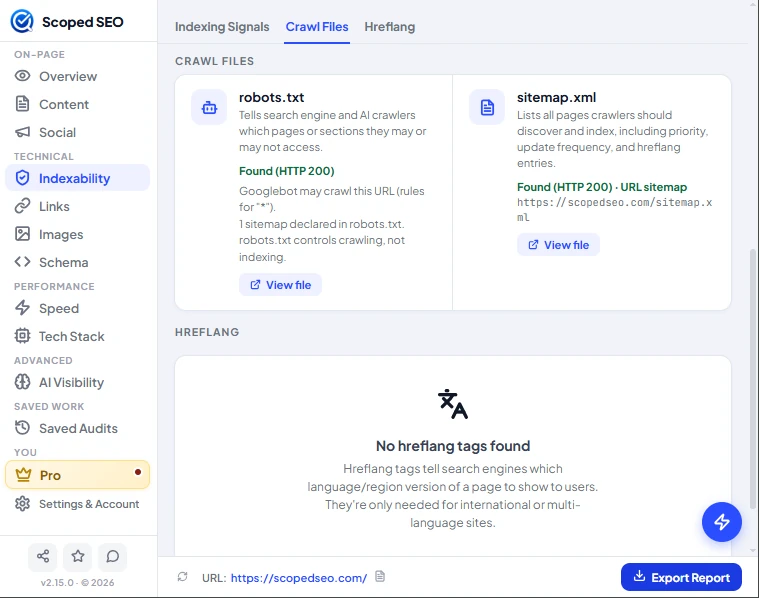
- robots.txt reads as found, not found, not accessible, server error or could not be checked. It also shows the sitemaps declared there and the rule that applies to Googlebot for this exact URL. robots.txt controls crawling, not indexing, and the card says so.
- sitemap.xml shows status and type for up to three same-origin sitemaps.
robots.txt rules are evaluated with the RFC 9309 matching rules: the specific user-agent group beats *, the longest matching pattern wins, Allow wins ties, and * and $ wildcards work.
Hreflang
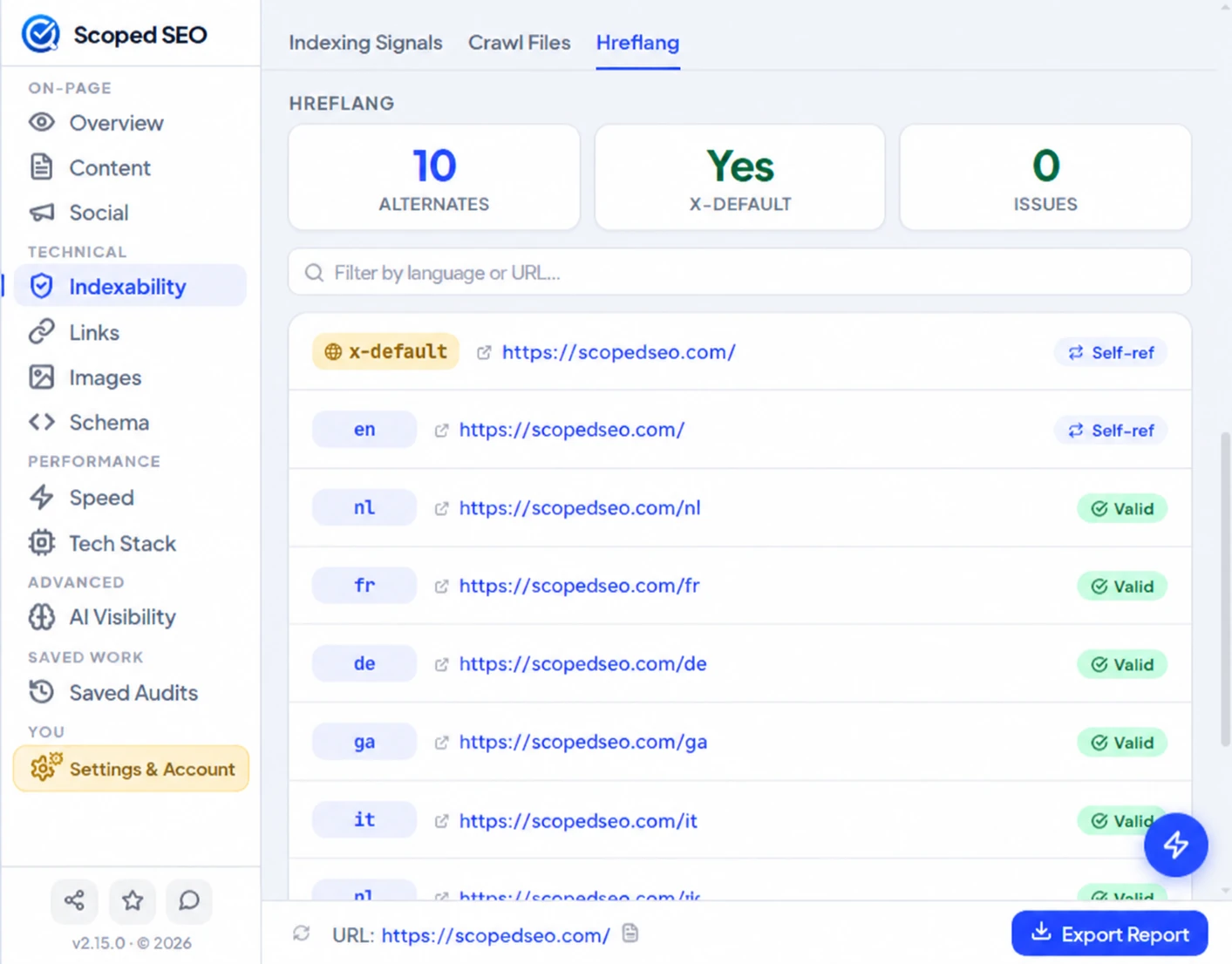
Three tiles count the alternates, show whether an x-default is present and count issues. A filter box narrows the list by language or URL, and each row carries a badge such as Self-ref or Valid. Hreflang tags are validated for bad language codes (underscores, jp, en-uk, region-only codes), relative or non-HTTP URLs, conflicting duplicates (an error) and exact repeats (a warning). The tab notes self-references and x-default. Return links are shown as Not Checked, since that would need requests to other pages. A page with no hreflang tags shows an explanation, not an error, because they are only needed for international sites.
What the checks never conclude
A timeout, a blocked request or a 5xx answer reads "could not be checked", never "missing". A 401, 403 or 429 reads as uncertain, not broken. robots.txt text itself is not stored, only the verdict.
noindex in the X-Robots-Tag header counts like a meta noindex.